Tasmanian Thipsels
A research blog
Chronological list of posts
Alerts for new posts: 
Micro-polydesmidan size and AI slop
Thipsels are tiny polydesmidan millipedes. Although this blog features Tasmanian species, there are tiny Polydesmida in temperate and tropical habitats all over the Earth.
Some specialists call them "micro-polydesmidans". Emboldened by this usage, at least one AI portal has decided this is a formal taxonomic grouping:

No, Bill Shear didn't erect this AI-imagined order. The AI source links go to Wikipedia's Polydesmida page, which doesn't mention micro-polydesmidans, and to a geoengineering article about "Micropolar Modeling of Shear Wave Dispersion". AI makes stuff up.
I'm not sure which thipsel is leading in the "I'm tiniest!" championships, but I don't think I've seen a Tasmanian polydesmidan less than ca 4 mm long as an adult.
That's also the lower limit I've observed for Polydesmida on the Australian mainland in the families Dalodesmidae, Haplodesmidae and Pyrgodesmidae, with the one exception of Inodesmus bonang (Mesibov, 2013) from East Gippsland in Victoria (Haplodesmidae, formerly in Agathodesmus), whose males are closer to 3.5 mm long than 4. They stand out in forest litter because they're white and contrast with the dark brown of soil and rotting wood.
The 4 mm lower limit (so far) in Australia is beaten by Ammodesmus granum (Ammodesmidae) in western Africa, with some adults less than 2 mm long:
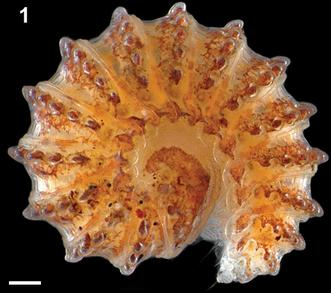
Adult male of Ammodesmus granum Cook, 1896 from Guinea (?) or Liberia (?); scale bar is 0.1 mm long. Source.
and by the ca 3 mm-long adults of some northwestern North American Polydesmidae:
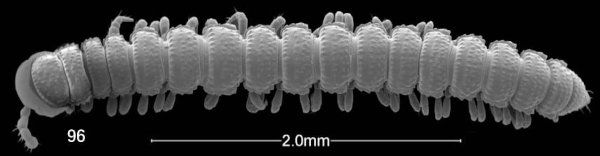
Adult male of Benedictesmus aureus Shear & Marek, 2021 from Oregon, USA. Source.
Two of the most diligent collectors of tiny North American Polydesmida and Chordeumatida have been Bill Leonard and Casey Richart. In 2022 I asked them how they found their tiny specimens. Leonard used an OptiVISOR and Richart used his (very sharp) unaided eyes. Here in Tasmania I use 2.5X magnifying reading glasses.
All three of us patiently look through "leaf litter and small woody debris" (Leonard quote) where the leaves are slow-decaying and fall from broadleaf tree species and large ferns. My best results are from litter of Eucalyptus species, Pomaderris apetala, Atherosperma moschatum and especially Olearia argophylla.
[Olearia argophylla was renamed Shawia argophylla in this 2025 publication. The 2025 Census of Vascular Plants from the Tasmanian Herbarium has the older name.]
2026-07-26
[Blog pause — back in August]