Tasmanian Thipsels
A research blog
Chronological list of posts
Alerts for new posts: 
Back home for another failed search
I spent the first week of August millipede-collecting on Kangaroo Island, SA, and the following week millipede-identifying at the South Australian Museum. The day after I returned to Tasmania I rummaged through leaf litter for several hours in yet another unsuccessful hunt for the elusive thipsel M18.
The Kangaroo Island trip was interesting for several reasons. About one-third of the island burned in the intense 2020 bushfires. The news services had images of blackened forest and bare ground in January 2020. Six years later, a tall, dense scrub of eucalypt suckers, bracken and fire-regenerated shrubs makes walking in the burned areas very difficult. In Tasmania we'd call it "bush-bashing".
Litter invertebrates seem to have recovered well from the fires. I saw plenty of snails, millipedes, centipedes, flatworms, earthworms, beetle and fly larvae etc. Kangaroos, brush-tailed possums and echidnas have also bounced back; I saw them as fresh roadkill.
The millipede fauna of Kangaroo Island is overwhelmingly dominated by introduced European julids, even in some natural areas. I saw in the field and in the Museum only five native millipede species: one Polyzoniida, two Polydesmida and two Spirostreptida. I'll describe one of the polydesmidans and one of the spirostreptidans in a taxonomic publication later this year.
I'd like to think that Kangaroo Island is large enough (ca 4400 km2) to have supported more than five native millipede species pre-settlement. Over the past two centuries, clearing and burning for agriculture have greatly reduced the native vegetation cover. This is particularly apparent on the more fertile soils that might previously have supported vegetation and micro-habitats more diverse than are seen today in the remaining uncleared areas. If there are indeed more species of native millipedes on the island, I suspect they're surviving only as small, fragmented populations in formal reserves.
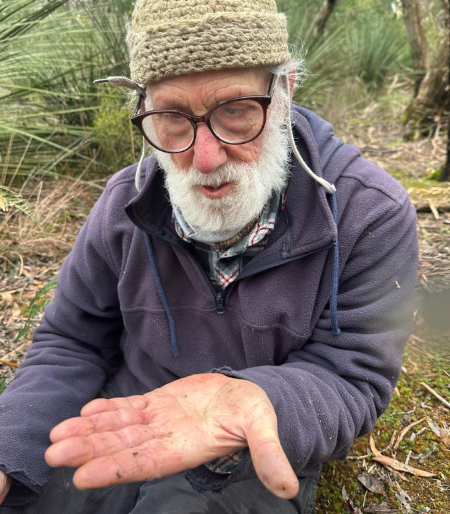
Me looking bemused at the first Polyzoniida (small, pale) recorded on Kangaroo Island. This particular patch of bush escaped the 2020 fires. Image by Richard Glatz, 2026-08-05.
2026-08-19